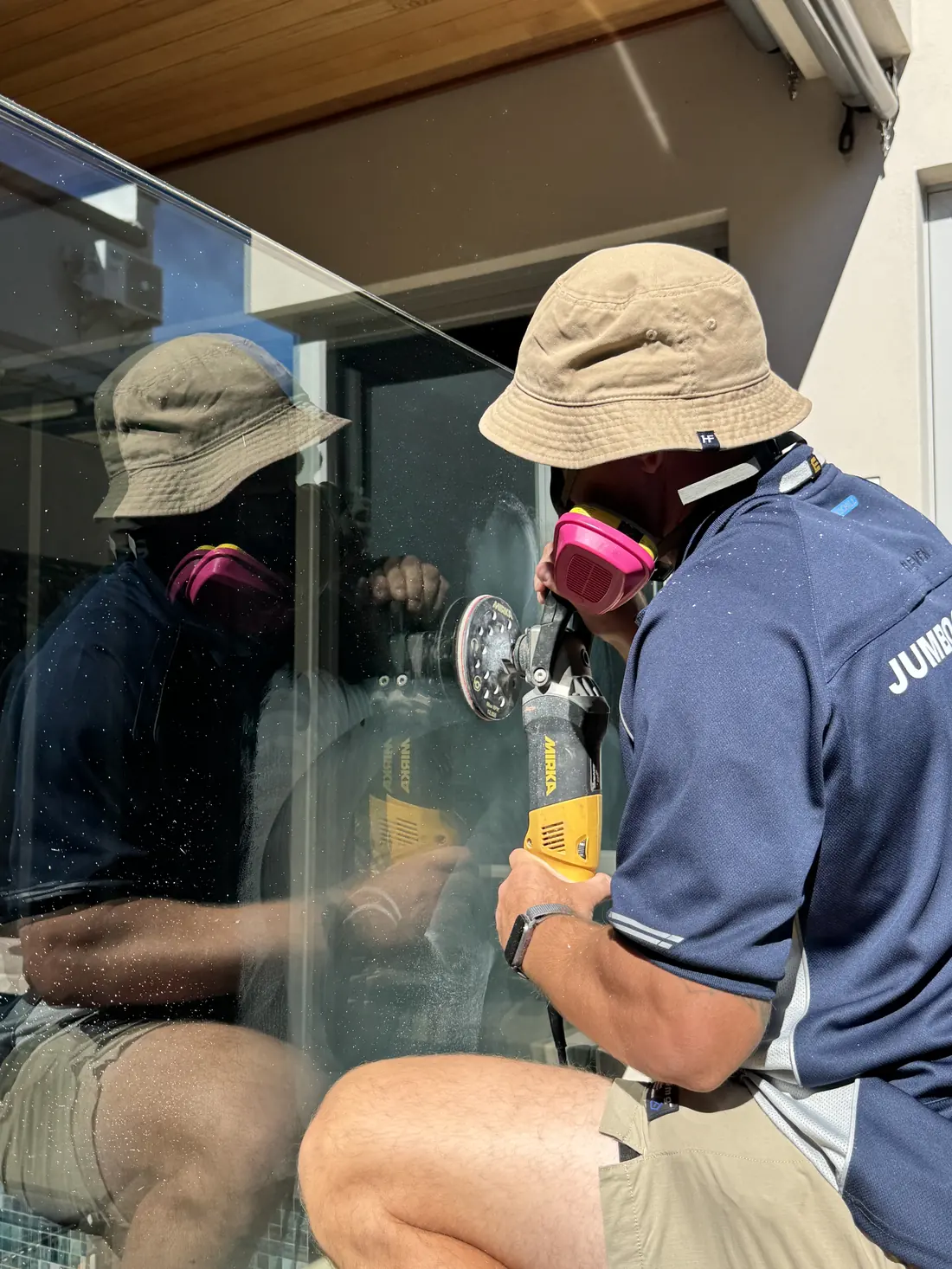
01The builders clean went wrong
A blade or scourer dragged over render dust, leaving fine parallel scratching across whole panes. The most common job we get, and almost always restorable.
02Render, mortar or grout splash
Cement slurry left to go off on unprotected glazing. Scraping it is what turns a clean-up into a scratch job, so it is worth a call before anyone reaches for a blade.
03Grinder sparks & weld spatter
Hot particles land and embed in the surface. They do not wipe off, they do not come off with a cloth, and every attempt adds scratching around them.
04A pane is scratched and the unit is weeks out
Toughened, laminated, oversized or double glazed. The remanufacture lead time is what actually moves your date.
05Coastal or site-adjacent sand haze
Wind-blown sand abrades whole elevations into a fine haze. Not one scratch but a whole surface, and it responds to the same process.
06Bore staining or etching at handover
Reticulation has been hitting the glazing all summer. Cleaners cannot shift it, because the mineral has polymerised into a film welded to the pane.
Restore in situ
One trade, one visit
- The glass never leaves the opening, so the facade is never open
- No open edge at height and no exclusion zone on the ground below
- No crane, scaffold or EWP booked to lift a unit in or out
- No unit to order and no remanufacture lead time
- Cut dry and dust extracted, so occupied floors keep trading
- Nothing moves on the programme
The work is done from wherever the damaged face can be reached, and the pane stays put either way.
Replace the unit
Everything else moves with it
- The unit comes out, and above ground level that opens the facade
- Height permits, edge protection, harnesses and anchor points
- Scaffold, EWP or craneage, plus an exclusion zone below
- Toughening or lamination lead time before any of it starts
- Trades coordinated around an open opening, then made good and resealed
The right answer when the glass is cracked. An expensive answer when the glass is only damaged on the surface, and we will tell you which one you have.
The one that decides it at height
Replacing a pane means opening the facade. Restoring it never does.
Above ground level the glass stops being the problem. Take a unit out and you have created an edge with a sheer drop behind it, and everything follows: working-at-heights permits, edge protection, harnesses and anchor points, scaffold, EWP or craneage, spotters, and an exclusion zone on the ground below. On a high rise or any multi-storey opening, that access and safety scope is usually most of the cost of the job.
Restoration works the glass where it sits. The opening is never open, so none of that scope exists. Damage on an external face may still need access to reach it, but never the removal sequence, and that is why the two columns above pull furthest apart exactly where the glazing is hardest to get to.